
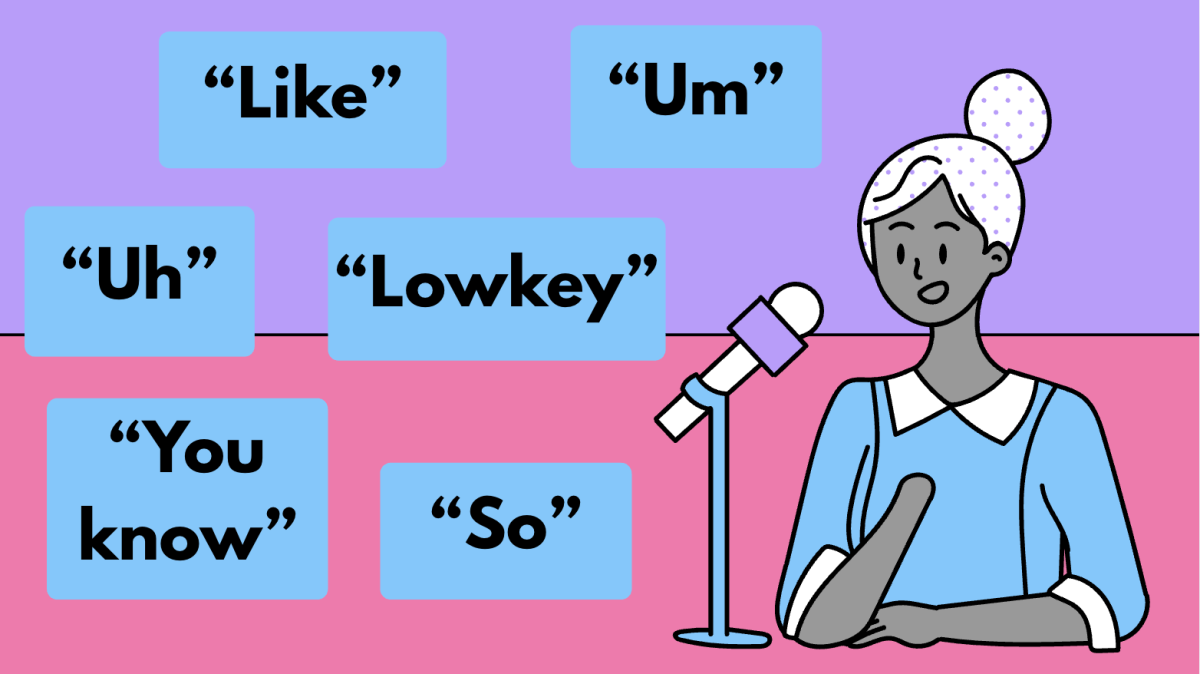
Public speaking has become the most common fear in the world. The countless rows of eyes tracking your every movement. The sense of dread in the pit of your stomach as you lose your train of thought. Many fill the awkward silence with words. “Um,” “like,” “uh” feel natural, yet these filler words may be harming your speech.
Filler words have become so intertwined with our speech that we don’t even realize we are saying them. At Darien High School, they have become a way to soften our delivery and create a sense of relatability. However, filler words often become a crutch that hinders our credibility.
According to the DHS Speech Pathologist, Dr. Kate Curcio, filler words have become “habitual”. Code switching, the use of different languages, dialects, or vernacular depending on who is being spoken to, is natural. As a result, filler words are often learned behaviors. When speaking with friends, people use words such as “like” to convey a sense of familiarity and informality in their speech. Others mirror this behaivor and it becomes a second nature.
Filler words, however, are often used no matter who is being spoken to. Whether it is a teacher, an adult, or during a presentation, filler words are often used inadvertently. This dictates how one is perceived.
In an observational study done at DHS, five students from each gender in every grade, 9th-12th, were asked the same prompt: “What is one thing you would change at the high school?” The number and type of filler words they used in one minute were then tallied. All 40 of the students were aware that the audio might be used for an article, and that elements of their response would be published.
On average, senior girls used the most “likes”, with 9 in one minute. The boys were more likely to use “um/uh” than girls, with the freshman boys averaging 7.8 “uh/um’s” in comparison to the freshman girls with approximately 3.4. The senior boys averaged 6.3 “uh/um’s” while the senior girls averaged 4.2.
The learned behavior of using filler words has directly corresponded with who others speak to. The girls who surrounded themselves with a majority of girls were more likely to use “like” than the boys. Many of the freshmen who had older siblings also mirrored their speech. The freshman girls who had sisters were more likely to use “like” than the freshmen girls with older brothers.
In total, the seniors averaged 13.25 filler words in one minute, while the freshmen followed closely with an average of 12.3. Seniors who have been at the school for four years were more likely to be susceptible to the learned behavior of using filler words and the reliance on them to avoid silence. Freshmen often used fillers to soften their statements and sound similar to the upperclassmen or their siblings. The sophomores and juniors had fewer filler words than the seniors and freshmen, but still averaged above 8 in one minute.
Over 75% of the students interviewed began their response with “um/uh” despite having time to think about their answer beforehand. Additionally, most students used filler words in the middle of their sentences without needing to take a pause. These words became blended into their dialect without many realizing it.
In the interview with Dr. Curcio, she emphasized how many associate the word “like” with a Valley Girl, a materialistic and affluent teenage girl. People often look down on those who overuse these fillers, seeing them as “airheads” and unintelligent. The filler word, “uh/um,” has often been used as a “turn-holding” word, a way to signal that someone is not done speaking. However, the presence of these filler words in high school is normalized and mirrored in all grades.
Despite this, Dr. Curcio pointed out that filler words do serve a purpose in conveying meaning and filling silence. They create personality and casualness in our speech; however, people have been conditioned to rely on them and use them mindlessly. When we use fillers too much, they ”lose the meaning behind it when there is meaning”.
Our culture views silence and pauses as inherently awkward and uncomfortable. People feel the need to constantly be speaking. The fear of public speaking is more of a fear of silence. Losing an idea, pausing, and taking a breath creates dread in people.
Collecting your thoughts and using silence to your advantage has been a key factor in the most powerful speeches. Former President Barack Obama is known for his measured pacing and calm, confident pauses without using filler words. By emphasizing the quiet, Obama had the ability to highlight certain points and give the audience time to reflect. Filler words are used as replacements for silence, however, silence has power when used correctly.
The more aware of the words you use, the more you can try to change them. Awareness is the first step towards progression.