With heavy workloads, hours of extracurriculars, and little time to sleep, shortcuts are necessary for students. The rise of Artificial Intelligence (AI) has become a way to reduce the heavy burden of homework and shorten the time needed to think, and even learn. With ChatGPT, Gemini, and Claude providing easy answers and fast methods, students at Darien High School (DHS) have begun to depend on AI in their daily lives.
According to a study performed at DHS, out of 200 students from all grades, 9-12th, 68% use AI on a daily basis. Only 1% of students surveyed had never used AI and 29% students use AI one to three times per week. Despite this frequent use, 84% of these students also claimed that students at DHS are too dependent on AI. Multiple students justified their responses by claiming “AI is the future” or that “the whole world is too dependent on it”.
Of those students, there was a wide variety in how they use AI. Between using it for answers/writing, brainstorming, studying, or search/guidance, 45% of students use AI for all of those functions. This includes creating study guides for their classes, synthesizing complex texts, and scheduling busy days. 25% of students use it primarily for studying, and 17% use it to find answers for “busywork”.
There were two extremes when faculty were asked about AI. Many teachers have fully embraced AI in creating worksheets, grading tests, and creating discussion questions. Others use paper assignments in order to prohibit the use of AI, as it could be a violation of “academic integrity”. When faculty were asked the same question, out of 20, 60% use AI for search and guidance where only 5% of students do.
There are a wide variety of AI tools that are used throughout the high school: 71% of students primarily use ChatGPT, 14% use Claude, and 10% use Gemini. Students who were more accustomed to using AI would refer to ChatGPT as “Chat” and some claimed they were on a first name basis with it.
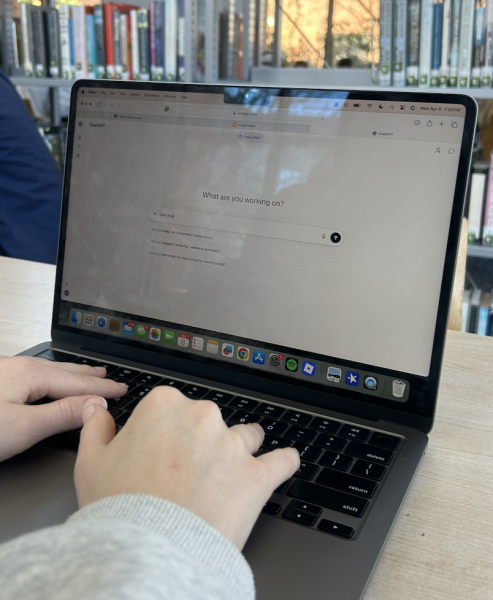
When faculty was asked, the majority used multiple types of AI for different functions. Over 10 students claimed that they are using AI because “teachers use it and we follow what we see”. There is a pressure to achieve high grades and students feel AI is necessary to use in order for teachers to give them the best grade.
AI has been around since the 1950s, when John McCarthy, a professor at Dartmouth College, coined the term at his summer workshop. Since then, AI has been constantly developed to use human data and knowledge to provide efficient, fast, and intelligent answers in seconds. In 2022, ChatGPT was created, an AI chatbot that follows a prompt and provides a detailed response. In 2026, ChatGPT had an average of 900 million active weekly users worldwide.
The dramatic rise in the use of AI has posed many issues. Specifically, students have become dependent on AI for answers and support. Dr. Jennifer Aaker, a Professor at the Stanford Graduate School of Business (GSB), teaches the class AI for Human Flourishing, which works to capitalize on AI’s use in fostering a creative and innately human life.
In Dr. Aaker’s class, every student was instructed to run an experiment that lasted a month on personalizing AI in one of five domains: Discovery, Pursuit, Balance, Impact, or Savoring. One student created a balance-focused AI chatbot that was used to savor daily moments. Another student focused on discovery by using AI to map career possibilities. With the personalization aspect, the Stanford GSB students were able to analyze how AI could aid in human experience.
In an interview with Dr. Aaker, the most unexpected thing she has learned was that using AI to remove “friction” lost the innately human aspect of overcoming challenges. Creating a rough draft or having a hard conversation might appear difficult, but when removed, human nature was compromised. By asking simply for answers, AI became amazing at scheduling, creating first drafts, and helping with research synthesis; however, it lost the “meaning-making”. Deciding what matters to students, speaking about challenging topics, and finding purpose in life were lost with the automated responses. By removing the challenge of overcoming adversity, “learning collapsed,” and students lost the ability to create their own meaning in their lives.
As AI continues to rise, the journey mindset becomes challenged. AI tempts students to skip the learning process and immediately write the answers. Rather, students who were the most successful in absorbing knowledge did not completely dismiss the use of AI. According to the assistant principal at DHS, Mr. Mark Mazzone, AI is useful “as long as it doesn’t replace thinking”.
In Dr. Aakers class, AI revealed how well students knew themselves. Rather than relying on answers, using AI to expand knowledge and appreciate the difficulties changed how students at Stanford saw themselves.
After all, according to Dr. Aaker, “technology works in service of humanity, not the other way around”. Removing the obstacles from everyday life provides simple and appealing solutions. Having all the answers seems like a shortcut to good grades and improving time management. In order to use AI to fulfill human experience, however, it must be used to broaden horizons and expand learning. If answers are all students seek, AI will remove the friction in life temporarily. The challenges may disappear, however, when that test comes around, or that hard conversation is necessary, “you’ve automated away the point of being alive.”