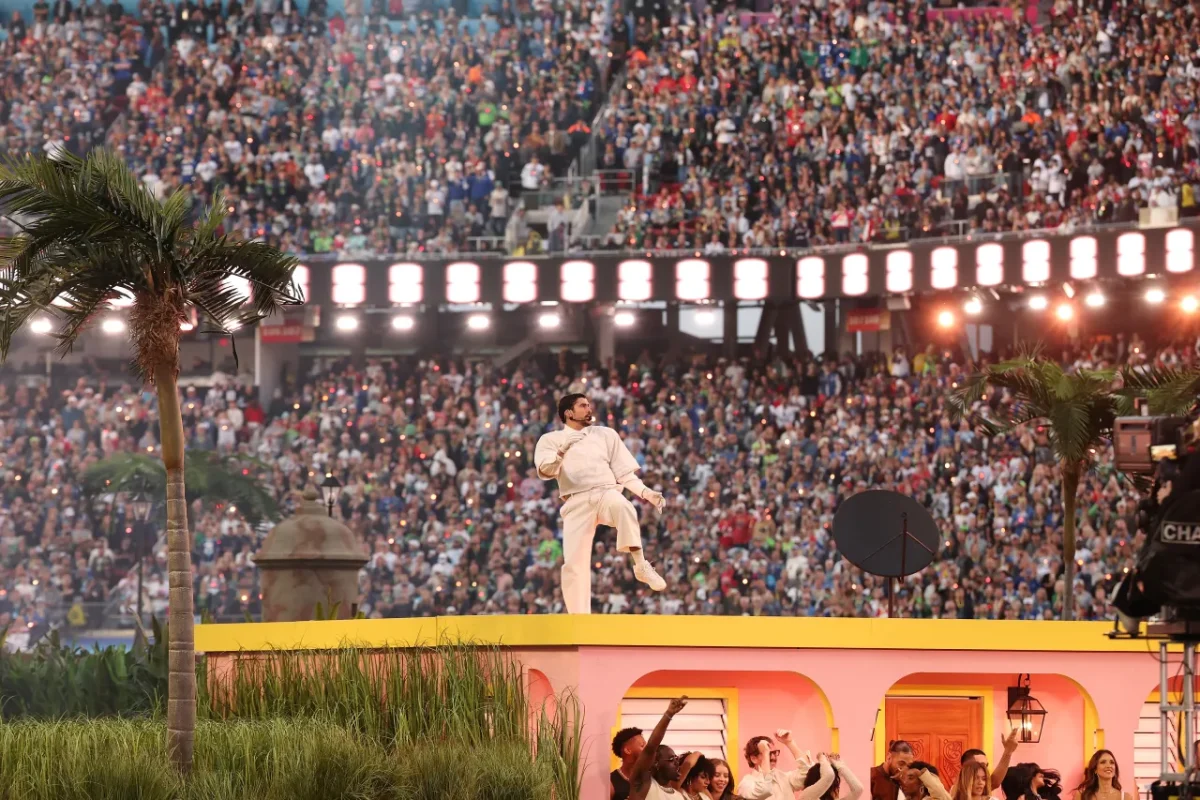
Close your eyes and imagine standing on a massive stage in the middle of the field. The lights explode on, the screaming begins, and you’re staring out at 80,000 fans. Cameras capture your every move from every angle so millions can tune in from home. All eyes are on you as you brace yourself to perform on the world’s biggest stage. Welcome to the
The 2026 Super Bowl halftime performer is Bad Bunny, a Puerto Rican rapper and singer, and the National Football League’s decision has sparked major backlash. Critics argue that Bad Bunny is not an “American” artist, despite Puerto Rico being a U.S. territory, because he sings primarily in Spanish and has expressed views that some interpret as anti-American. Supporters countered that Puerto Ricans are U.S. citizens and that the halftime stage reflects the country’s cultural diversity.
Traditionally, Super Bowl halftime performers have come from pop or hip-hop genres to appeal to the widest possible audience. In recent years, however, the show has begun featuring performances that carry stronger cultural or political meaning. Halftime shows, such as Kendrick Lamar’s emphasis on Black culture, have led some viewers to question whether these themes distract from the entertainment itself. As a result, some critics are asking why an artist whose music and public views challenge traditional ideas about American values and government would be placed on the nation’s biggest stage, and whether public reaction is driven more by the performance or by the message it may convey.

When the Darien High School community was asked their opinions about Bad Bunny’s halftime performance, the responses were mixed but largely positive. However, students focused on different aspects of the show. Some paid close attention to the political and social messaging, while others commented more on the singers, dancers, and overall performance quality.
At the end of the performance, the words “The only thing more powerful than hate is love” appeared on the big screen, delivering a clear and intentional message. For many students, this moment stood out the most. Several said they appreciated the statement, with one student from the survey explaining, “It was exactly what the world needed at this moment.” Others viewed it less as a political stance and more as a universal message about love and unity, which is a theme that is commonly used in music and other forms of art. At the same time, some students considered the complex issues and heated debates happening in our society today.
The representation of different South American countries also sparked varied responses. Some students felt uncomfortable with it, while others deeply appreciated the visibility. For a few, it was especially meaningful. One student respondent shared that what they liked most was that “I saw my flag and he called out my country,” showing how personal and powerful that moment felt.

When it came to the performance itself, many students liked the dancers and enjoyed the singing. Some noted minor issues, such as microphone quality or the show’s length. The most common criticism, however, was difficulty understanding the lyrics because the performance was primarily in Spanish, with one student remarking that “anything in English would have been better.”
When asked whether they would have preferred a different performer, responses varied widely. Suggestions ranged from Benson Boone and Ariana Grande to Pitbull, Bruce Springsteen, Drake, Arctic Monkeys, Laufey, Bruno Mars, and Zach Bryan, among many others. The wide range of answers highlights how difficult it is to satisfy an audience of millions with a single performance.
Despite the controversy, the broadcast was still highly viewed. Bad Bunny’s performance averaged 128.2 million viewers, making it the fourth most-watched halftime show behind performances by Kendrick Lamar, Michael Jackson, and Usher. While not record-breaking, the viewership numbers were still up there.

This year also saw an unusual development, a competing halftime show. Turning Point USA, a conservative political organization founded by Charlie Kirk, hosted an alternative halftime event featuring Kid Rock. About five million viewers tuned into the livestreamed event, called the “All-American Halftime Show.” Traditionally, the only halftime performance is produced by Apple Music and embedded in the game broadcast.
Political figures also weighed in. President Donald Trump criticized the selection, calling it “absolutely ridiculous” and stating he had never heard of the artist. The reaction reinforces how the halftime show, once viewed purely as entertainment, has become a vessel carrying cultural and political debates in today’s society.
Ultimately, the controversy surrounding this year’s halftime performance reflects a larger national conversation about identity, representation, and unity. Whether viewers tuned in for the music or the message, the Super Bowl halftime stage once again proved to be more than just a performance; it served as a representation of America’s growing political divide.