
It sounds weird. Two robots falling in love as they travel across South Korea to find one of their old owners. But this weird musical managed to get fourteen good reviews and win six Tony® awards. Making it the winningest musical of the 2024-25 Broadway season.
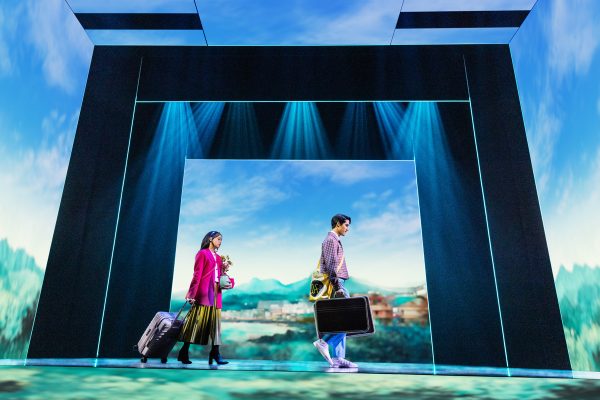
The lights come up on a plant and a robot puttering around his room, going about his life in the HelperBot Yards, an apartment complex where retired or old-model HelperBots live out the rest of their lives. Oliver, the aforementioned robot, seems content to keep to himself, listen to his jazz, and take care of his plant for years, until one day there is a knock at his door. It turns out to be Claire (a newer-model robot who lives across the hall) whose charger has broken and desperately needs to borrow his before she runs out of battery. He lets her in, and what follows is the biggest adventure of their lives.
While the story is incredible, it’s not the only thing that makes this musical great. The score (by Will Aronson and Hue Park, who also wrote the book) is a blend of modern theater music and crooner jazz, expertly sung by Dez Duron, who plays the character Gil Brently. Jesse Green, head theater critic for The New York Times, describes the songs as “mostly upbeat, busy numbers, stylistically landing somewhere between Bacharach and Sondheim” in his article ‘Maybe Happy Ending’ Review: For Robots, Is It Love or Just a Hookup?
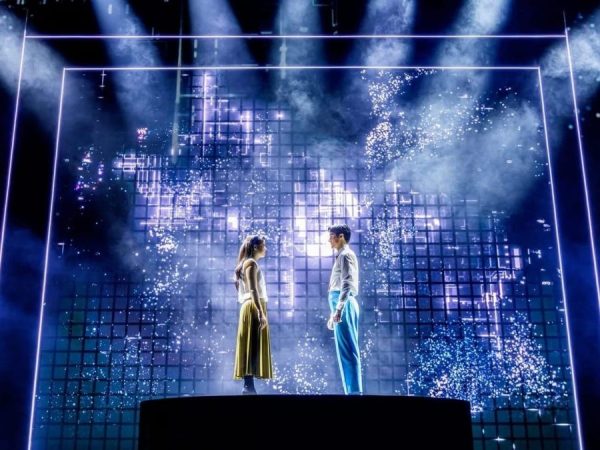
The scenic design by Dane Laffery moves organically with the performance. Compartmentalized spaces that slide on and off the stage, and a series of scrims, serve as viewfinders: drawing your focus to certain things and giving you a window into Oliver and Claire’s little world. The use of screens may seem aggressive, but that aggression pays off when all the screens, projections, and lighting (design by Ben Stanton and George Reeve) work together to transform the stage into the inside of Claire’s mind or a firefly forest on Jeju Island. The incredible design is described best by Michael Sommers in his artice Maybe Happy Ending: Beguiling Musical Charmer from Korea in the New York Stage Review: “Among the musical’s highlights is the unexpectedly lovely “Never Fly Away” sequence when Oliver and Claire view the fireflies and the orchestra materializes upon a turntable revolving around them; a gentle yet memorable interlude generated by the designers and artists.”
The performances by the original cast are incredible. Darren Criss (as seen on Glee), who plays Oliver, fully embodies a robot and even won one of the show’s Tonys® for his performance. Helen J Shen, who plays Claire, a newer model of HelperBot, shows a distinct difference between the older model (Oliver) and herself, with truly unparalleled physical acting. Marcus Choi plays all of the humans in the musical (surprisingly, a lot of roles), and Dez Duron (The Voice) plays the jazz crooner Gil Brently. Even though there are only four actors in the show, it feels larger because of how big each performance is.
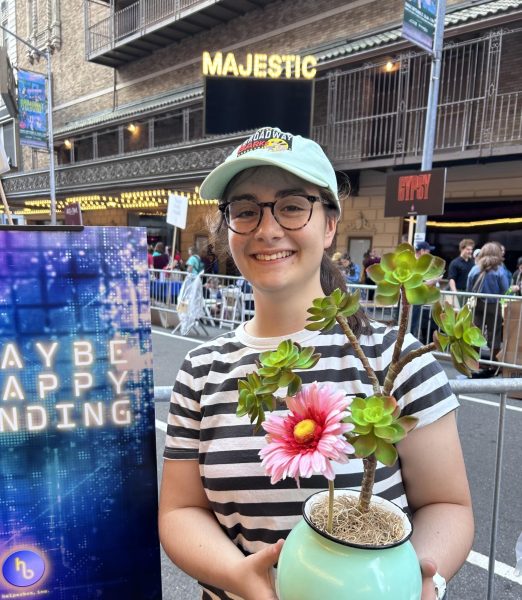
The best performance of the show, however, is by the diva himself, the houseplant: HwaBoon. He is the only living object in Oliver’s apartment and represents the constant presence of humans throughout the story. Oliver cares for him, always serving humans, doing what he was programmed to do. Claire gets annoyed that Oliver’s best friend is his plant, and can’t seem to get past the fact that he won’t fight his programming and leave the human world behind. HwaBoon is truly a pillar of the story, and I even got to speak to him for a few minutes back in September (although he wouldn’t let me quote him).
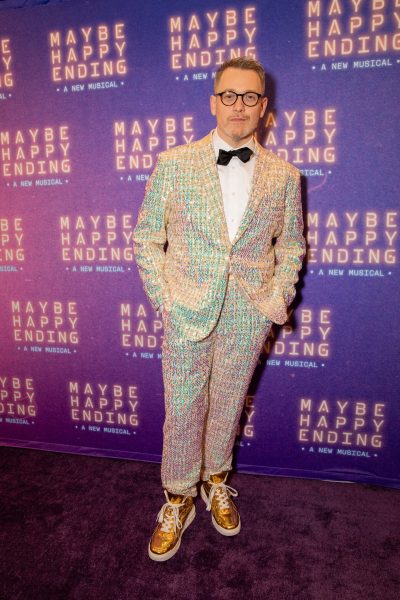
But what truly makes this show special is the direction by two-time Tony® Winner Michael Arden. He is truly the reason the show works, bringing together all the elements of set design, projection, lighting, sound, and even the book and score to create a production that works as one. When talking about integrating all of these parts in an interview with Variety, he says, “It’s incredibly complex. The video, lighting, automation, scenery, props, action, and music all have to work in such tandem, with such interlocking synchronicity, that it was both a challenge and so delicious to work on, because it really took all departments thinking outside of their own purview a little bit, which is the way I love to work.”
Now, I’d like to leave you with the first line we hear in the show, which truly embodies the work and what it’s really about. “Why love?”