

Every year, people fill out brackets for the NCAA Basketball Tournament, convinced they’ve cracked the code. And every year, within hours, all of those brackets fall apart. A 12-seed beats a 5-seed. A buzzer-beater shocks the nation. Fans call it luck, chaos, or just plain madness.
But what if these upsets aren’t as random as they seem?
Before I conducted even an ounce of research, I consulted a friend of mine, sophomore Christian Lewis. I first asked him which team do you think will make something close to a Cinderella run, he replied VCU (Virginia Commonwealth University), I called him completely delusional afterward. But, I then asked him off of that, how he expected an 11 seeded team to beat 6 seeded North Carolina. He ended up speaking on so many stats, I think I could right this entire article solely about his response. During that entire spheal where I
completely zoned out, it hit me, and the answer to this article is literally everything plays into a March Madness upset.
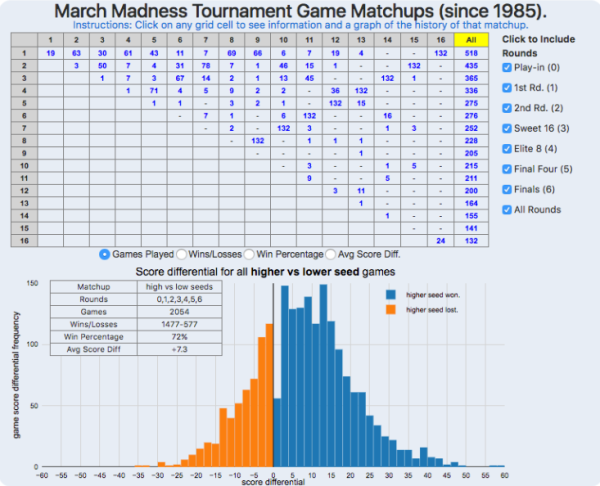
As data-driven sports analysis site FiveThirtyEight explains, “the single-elimination format introduces a lot of randomness into the tournament,” meaning that unexpected outcomes aren’t actually rare—they are built into the competition itself. The tournament format itself makes upsets more likely. March Madness is single elimination, meaning one game ends a team’s run. As FiveThirtyEight summarizes, “a single-elimination tournament is a breeding ground for upsets,” because randomness plays a much larger role than in multi-game series.
First, it’s down to simple probability. Even the best teams in the country are still not guaranteed to win every game. According to FiveThirtyEight’s tournament models, even a No. 1 seed can have a meaningful chance of losing early because “even great teams lose sometimes,” especially in a single game scenario. Whilst dozens of games are played all at once in a single round, numerous small chances of failure add up quickly, making multiple upsets statistically very likely.
Also, seeding can never be perfect. Teams are ranked

based solely on their full-season performance, but that doesn’t fully reflect how they will play in March. The NCAA itself notes that “teams can improve or decline over the course of a season,” meaning that seeding may not perfectly live up to a team’s true strength when it’s tournament time.
Even the matchups can also play a huge role. Basketball is never just about which team is better than the other but how teams’ styles interact. As basketball analytics pioneer Dean Oliver writes in Basketball on Paper, “the key to winning is to maximize your strengths and exploit your opponent’s weaknesses,” This emphasizes how certain styles can create unexpected advantages for underdogs.
Although the statistic that’s proving to be deciding for an upset or not is the three-point shot. Teams that rely heavily on three-pointers introduce more variability into the

game. As ESPN analysis has pointed out, “the 3-pointer is the great equalizer,” which allows for less talented teams to compete with strong opponents if they’re dangerous from 3.
There is also a psychological side to upsets. Higher-seeded teams often face intense pressure to win, while lower-seeded teams can play more freely. Sports psychology research has shown that “pressure can negatively affect performance in high-stakes situations,” which helps explain why favorites sometimes struggle late in close games .
In the end, March Madness lives up to its name. But the chaos we see each year isn’t completely random. It’s the result of probability, imperfect rankings, matchups, and human emotion all colliding in a high-pressure, single-elimination tournament.